Zoo mesh is the barrier system — welded wire, chain link, or knotted and ferruled stainless steel rope — that forms the walls and roof of a zoo enclosure, and it is defined by three numbers: aperture, strand diameter and material grade. Almost everything else about an enclosure follows from those three figures: whether a macaque can reach a visitor's camera, whether a gazelle is visible at 80 m, whether the structure reads as landscape or as a cage from the car park. Specify them well and the mesh disappears. Specify them badly and you get an escape, an injury, and a rebuild inside ten years.
This guide is written for zoo architects, exhibit designers, park operators and procurement teams who have to specify zoo mesh for a live project — and defend that specification to an inspector. It covers the five mesh systems on the market, how aperture is chosen species by species, how structural spans work, what the materials cost in 2026, and the mistakes that force enclosures to be rebuilt early.
Zoo mesh at a glance (key facts)
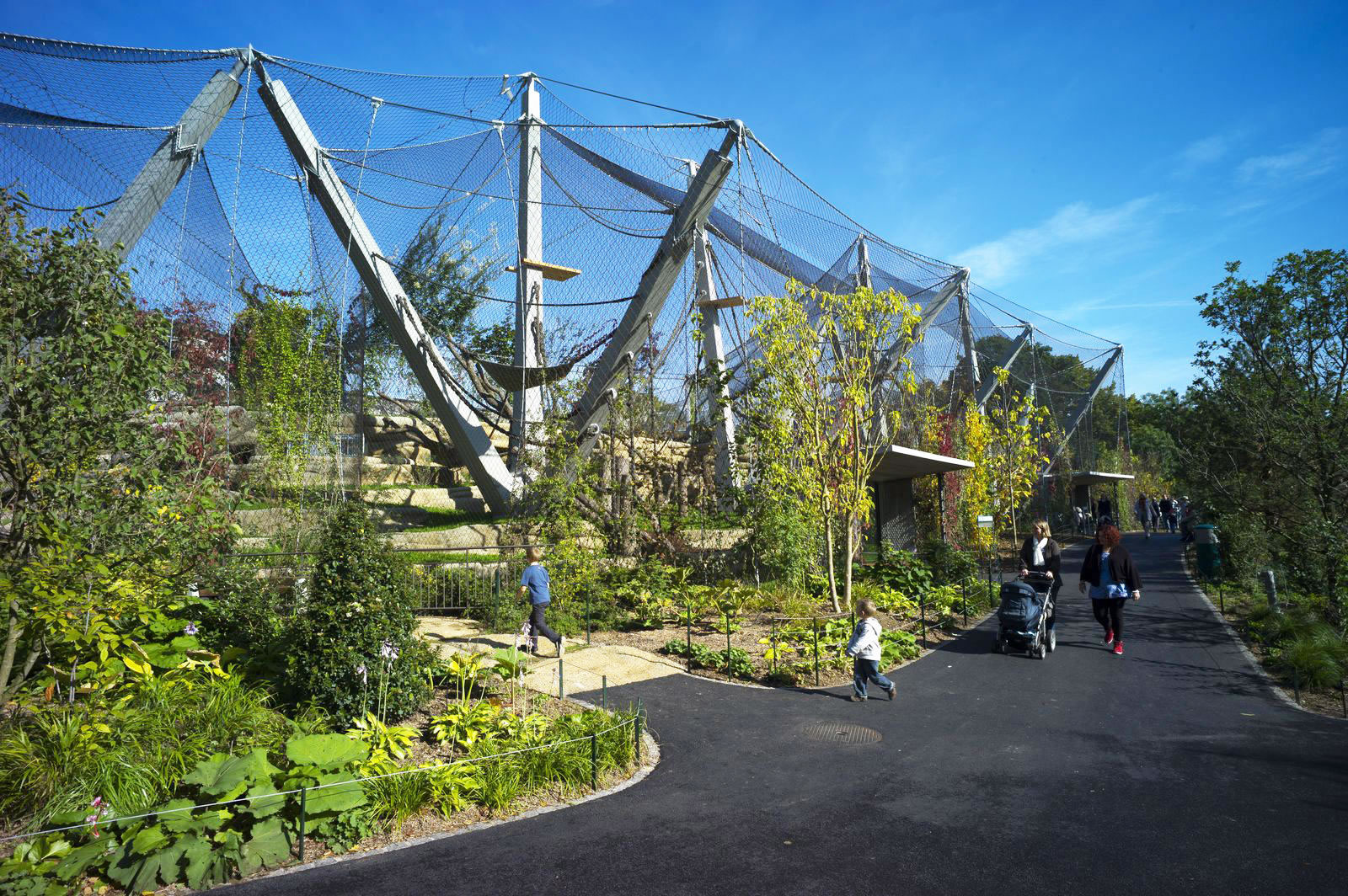
A primate enclosure formed from one continuous cable-net surface over raking masts. Because the net spans the whole volume, no internal posts are needed — which is why the habitat reads as landscape rather than cage.
Every zoo barrier on the market belongs to one of two families. Wire-based systems are made from stiff wire welded, woven or twisted into a rigid sheet, and they carry load by stiffness: a panel is fixed to a frame and the frame takes the force. Rope-based systems are made from flexible stainless steel wire rope, and they carry load by tension: the net is stretched between anchors and distributes an impact across the whole surface. That single difference explains almost every cost, span and welfare argument that follows.
Wire systems are cheap, fast to install, and adequate for hoofed stock, holding pens and service areas. Rope systems cost three to ten times more per square metre and are the only realistic choice for primates, large carnivores, walk-through exhibits and any enclosure where the barrier has to disappear visually.
| Wire-based system | How it is made | Aperture / wire | Where it works | Where it fails |
| Galvanised welded mesh | Low-carbon wire welded in a square grid, hot-dip zinc or Zn-Al coated | 25–100 mm / 2–5 mm | Hoofed stock, holding pens, petting areas, service yards | Sheds zinc onto grazing; rusts from every cut edge |
| PVC-coated welded mesh | Galvanised core with a bonded PVC sleeve, usually green or black | 25–50 mm / 2–4 mm | Aviaries, small mammal runs, education and back-of-house | Coating cracks under UV, then rusts invisibly beneath it |
| Chain link | Wire spiralled and interlocked into a diamond pattern | 40–75 mm / 3–5 mm | Perimeter fencing, service boundaries, temporary works | Double wire at every edge reads as a cage; toes and hooves catch |
| Rope-based system | How it is made | Aperture / rope | Where it works | Where it fails |
| Knotted (hand-woven) rope mesh | 304 or 316 wire rope, hand-knotted at every crossing, no ferrules | 20–200 mm / 1.5–4 mm | Primate climbing frames, aviaries, walk-through exhibits | Knots add visual bulk; hand work means long lead times |
| Ferruled rope mesh | Rope fixed at each crossing with a crimped stainless sleeve | 30–120 mm / 2–5 mm | Large panels, heavy animals, roofs with high wind load | Highest cost per m²; sleeves must match rope grade |
| Structural cable net | 6–12 mm cable on a tensioned grid, clamped at crossings | 100–300 mm / 6–12 mm | Whole-enclosure roofs over big cats and primates | Needs structural engineering, masts and a real tensioning plan |
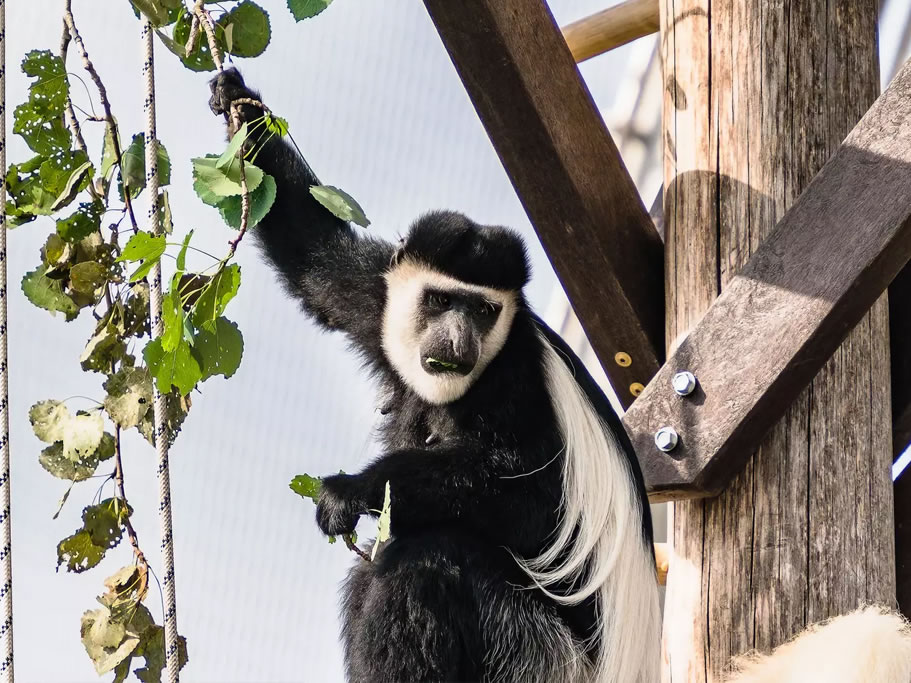
Hand-woven rope mesh behind a timber climbing frame. The animal's full hand wraps the frame, not the mesh — which is the point: rope mesh is a barrier, not a climbing surface, and it should be detailed so that animals do not routinely load it.
The choice between the two families is usually made for the wrong reason — first cost. A galvanised welded panel at US$10/m² looks like a bargain next to rope mesh at US$60/m², until you price the frame that carries it, the repainting, and the replacement at year twelve. We compare those numbers honestly in the hand-woven stainless steel rope mesh and wire rope ferrule mesh ranges; the short version is that rope systems win on any enclosure intended to stand for more than fifteen years, and wire systems win on anything temporary or back-of-house.
A zoo mesh quotation is only comparable if both parties mean the same thing by “60 × 60 mm”. In the rope mesh trade, that figure is almost always the centre-to-centre pitch — the distance from the centre of one rope to the centre of the next. It is not the clear opening an animal sees. The clear opening is smaller by one rope diameter, so 60 mm pitch in 3 mm rope gives a 57 mm hole, and 60 mm pitch in 4 mm rope gives 56 mm. On a batch of quotations that difference is enough to change which product you are actually buying.
Five numbers should appear on every zoo mesh datasheet. If one is missing, the quote is not yet a specification:
A specification that omits edge construction is the single most common reason two “identical” quotes differ by 40%. One supplier is pricing a knotted border, the other a thimble-and-sleeve termination that costs three times as much and lasts twice as long.
The enclosure type sets the mesh before species detail is considered, because type fixes the volume, the span and the way animals load the barrier. The table below is the short version we use when a project first arrives; treat the apertures as starting points to be confirmed against the actual species list.
| Enclosure type | Typical size | Mesh system | Aperture | What decides success |
| Primate island / climbing frame | 8–20 m high, 200–2,000 m³ | Knotted rope mesh or cable net | 40–50 mm | Gap-free detailing at every junction — primates test joints, not panels |
| Walk-through aviary | 300–20,000 m³ | Knotted rope mesh | 25–50 mm | Double-door airlock and mesh that birds cannot abrade against |
| Big cat perimeter | 4.5–6 m high | Cable net or ferruled rope mesh | 50–100 mm | Paw cannot pass beyond the wrist; roof overhang plus buried apron |
| Hoofed stock paddock | 2–3 m high | Galvanised welded mesh or cable | 100–150 mm | No leg-sized gap at ground level; smooth lower edge |
| Bear / large carnivore | 5–7 m high | Cable net, 8–10 mm | 75–100 mm | Destructive strength plus climbing ability — test the anchors, not the net |
| Small mammal / reptile | 1.8–2.4 m high | Welded mesh or ferruled rope mesh | 12–25 mm | Aperture below head width; glazing where humidity control matters |
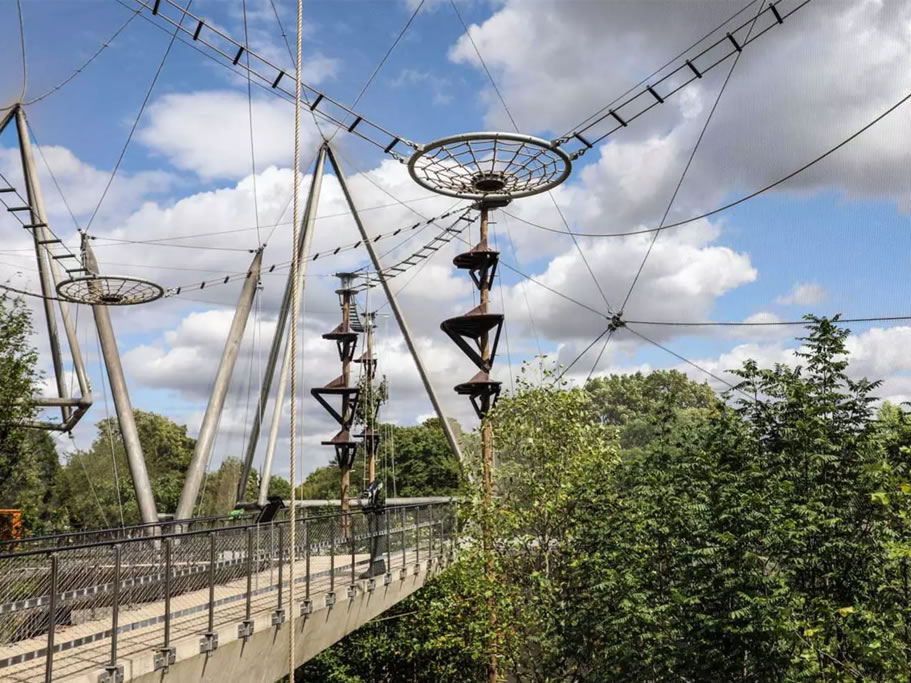
Net carried over a visitor route, not just around a paddock. Roofing the path is what turns a fence into an exhibit — the barrier is above the visitor, the sightline stays open, and the enclosure gains volume without gaining footprint.
Most modern zoo enclosures are composites rather than pure mesh boxes, and the proportions matter. A typical arrangement is solid rockwork or glass to 1.0–1.2 m at visitor level — enough to stop a child reaching through and to hide the animal's feet — with mesh above and overhead. The mesh then only has to be escape-proof and visually quiet, not child-proof at arm's length. That detail alone frequently lets a project drop one aperture size and save 15–20% on net area. For the full range of habitat types this applies to, see our animal enclosure mesh systems.
Aperture is a welfare decision before it is an engineering one, and it comes down to two rules that are usually stated badly.
The head rule. An aperture must be either smaller than the animal's head at its widest point — measured behind the eyes, including ears — or large enough that the whole head passes freely. The dangerous band is the middle: openings the head can enter but the shoulders or ears cannot follow, where an animal pushes forward and then panics. This is why a 50 mm mesh that is generous for a capuchin is genuinely risky for a marmoset.
The limb rule. The same logic applies to hands, feet and hooves. An opening is safe if it is too small for the limb to enter, or large enough that the limb passes through to the shoulder or haunch without the elbow or knee locking against the wire. Anything in between — roughly one and a half to two times the limb diameter — is a snare. It is also why square welded mesh is a poor choice for climbing primates while a flexible rope net, which deforms under load instead of holding a fixed gap, is far more forgiving.
Three species groups need special treatment. Cats are measured from the wrist to the claw tip, not from the paw pad, because a cat hooks rather than grips. Horned and antlered stock need apertures either narrower than the horn base or wider than the full spread, never in between. And parrots can cut soft galvanised wire with the beak over years of repeated testing, which is the main argument for stainless in any mixed walk-through aviary.
| Species group | Head width (adult) | Recommended aperture | Why |
| Marmoset, tamarin | 40–50 mm | 20–25 mm | Infants pass a 30 mm hole; this is the smallest standard aperture in stock |
| Capuchin, spider monkey | 55–70 mm | 30–40 mm | Strong fingers work at knots and ferrules — specify a thimble edge |
| Macaque, baboon | 80–120 mm | 40–50 mm | The default primate mesh; pair it with 3 mm rope minimum |
| Chimpanzee, gorilla, orangutan | 130–180 mm | 50–80 mm, 4–5 mm rope | Aperture is easy here; strength is the real constraint |
| Lion, tiger, leopard | 180–240 mm | 50–100 mm | Paw cannot pass beyond the wrist; roof needed, not just walls |
| Small birds, finches | 25–35 mm | 13–25 mm | In mixed exhibits, always specify to the smallest species present |
| Macaw, cockatoo | 50–60 mm | 50–60 mm | Beak cannot open 3 mm stainless; galvanised wire it can |
| Gazelle, antelope | 120–180 mm | 100–150 mm | Horns are the risk, not the head: avoid the in-between sizes |
Figures are for adult animals and assume a single-species exhibit at normal stocking density. For mixed-species walk-throughs the governing aperture is always the smallest head present, and for breeding groups it is the smallest infant head present — a distinction that has caught out more than one exhibit that passed inspection on opening day and failed two seasons later.
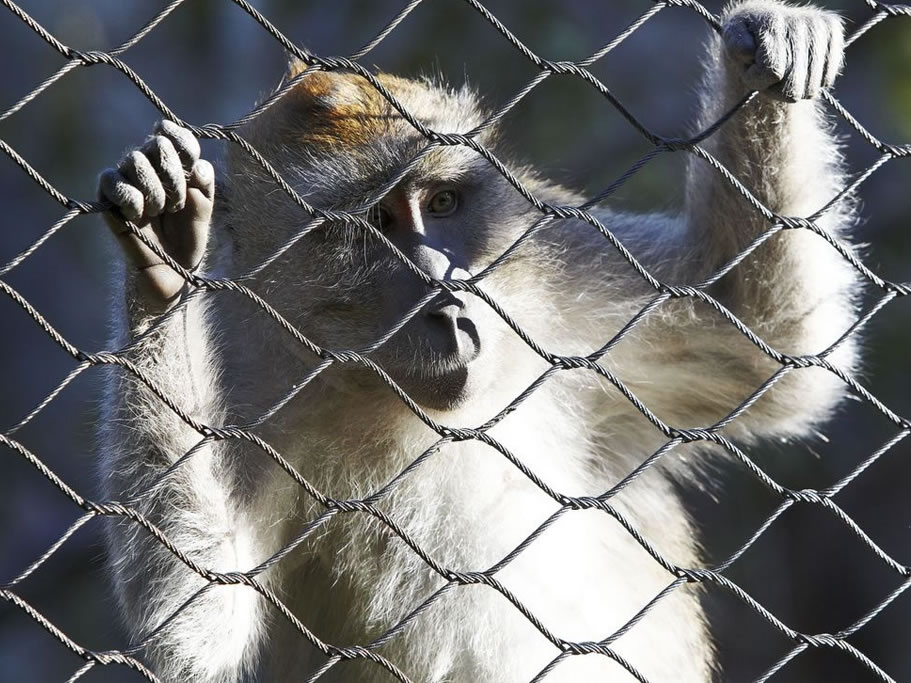
Why aperture is measured, not guessed. The fingers pass the opening comfortably; the head does not. Note also how the net deforms under the animal's weight instead of holding a rigid gap — the behaviour that makes rope mesh safer than welded panels for climbing species.
Strength and aperture are separate decisions, and conflating them is expensive. A 50 mm aperture can be built from 2 mm rope or from 5 mm rope; the first suits a capuchin, the second a chimpanzee, and the price difference is roughly four to one. Work backwards from the load cases the barrier will actually see, not from the species' body weight alone.
Four load cases govern a zoo net in practice. Animal impact — a running charge, or a primate swinging into the surface — is a dynamic load several times body weight, applied over a small area. Climbing and hanging concentrates an adult's mass on a few strands, often at the top edge where the net meets the frame. Wind and snow act on the whole surface and usually govern the masts and anchors rather than the mesh. And human load is the one everyone forgets: maintenance staff, tree surgeons and, occasionally, a visitor who climbs the barrier.
| Rope diameter | Typical breaking load (7×7, 316) | Equivalent | Typical zoo use |
| 2.0 mm | 3.9 kN | ≈400 kg | Marmosets, small birds, decorative panels |
| 3.0 mm | 8.8 kN | ≈900 kg | Macaques, capuchins, most walk-through aviaries |
| 4.0 mm | 12.5 kN | ≈1,270 kg | Great apes, large cats, high-wind roofs |
| 5.0 mm | 19 kN | ≈1,940 kg | Bears, elephant restraint, exposed coastal sites |
| 6.0 mm | 28 kN | ≈2,850 kg | Structural cable grids over large volumes |
| 8.0 mm | 50 kN | ≈5,100 kg | Primary roof cables and mast guys |
Two cautions on that table. First, breaking load is not design load: a net carrying animals should be designed at one quarter to one fifth of the strand's breaking load, and at one fifth or better where the public walks underneath. Second, a net is not a bundle of independent strands — load redistributes across the mesh, which is why a 3 mm net with a well-tensioned thimble edge outperforms a 4 mm net stapled to a frame. If you need the arithmetic for a specific panel, our note on load-bearing capacity of stainless steel rope mesh walks through it.
Both are austenitic stainless steels and both are non-magnetic, so a magnet test proves nothing. The difference is molybdenum: 316 contains 2–3% Mo, which is what resists chloride pitting. In practice that means 304 will develop brown “tea staining” and eventually pit within a few kilometres of a coast or beside a chlorinated pool, while 316 in the same place stays clean for decades. The premium for 316 is typically 15–25% on the mesh, which is trivial against the cost of replacing a net over a live habitat.
| Environment | Grade | Reason | Expected life |
| Inland, temperate, low pollution | 304 | Chloride levels too low to pit | 25–30 years |
| Coastal, within 5 km of sea | 316 | Airborne salt deposits concentrate in crevices | 20–30 years |
| Poolside, marine mammal, splash zones | 316L | Chlorine plus permanent wetting; low-carbon grade for welds | 15–25 years |
| Indoor rainforest house | 316 | Condensation never dries; guano is acidic | 20–25 years |
| Perimeter, service yard, back-of-house | Galvanised (Zn-Al) | Cost; appearance is not a design driver here | 8–15 years |
Grade choice cannot rescue bad detailing. A 316 net clamped with mild-steel bolts, or sitting in a pocket where rainwater and leaf litter collect, will corrode at the clamp long before the strand fails anywhere else. Keep fixings the same grade as the mesh, specify isolating washers between stainless and aluminium, and make sure every horizontal ledge either drains or is detailed out.
Every zoo claims its mesh is “virtually invisible”. There is a way to check. Open area is the share of the panel you can see through, and for a square or diamond net it is close to:
open area ≈ (1 − d / p)² × 100
where d = strand diameter, p = centre-to-centre pitch
Run the numbers and the marketing falls away. A 3 mm rope at 60 mm pitch is 90.3% open; a 4 mm rope at 50 mm pitch is 84.6%; a 4.5 mm chain-link wire at 50 mm pitch is 82.8%. The gap between the best and worst of those is only eight percentage points — which is why open area alone does not explain why one barrier disappears and another reads as a fence.
Three other factors do most of the work. Uniformity: a rope net has a single strand diameter everywhere; chain link has doubled wire at every diamond edge, so the eye reads a heavy zigzag even at 80% open area. Sheen: bright zinc reflects sky and reads as a bright veil; matt stainless against vegetation reads as shadow. Shadow: a net throws a hard, high-contrast pattern on the ground in sun, and that pattern is often more visible than the net itself.

The same net, two different jobs. Here the rope mesh forms the climbable volume of the habitat as well as the barrier — which is only possible because rope mesh deforms rather than holding a rigid, limb-sized gap.
For interpretation design there is one more test worth running before the net is ordered: stand at the visitor rail and look through the panel at a printed sign 20 m away. If the mesh pattern dominates the sign, the aperture is too small for that viewing distance or the strand too bright, and no amount of planting will fix it. Zoo photographers will also complain about moiré — the interference pattern produced when a regular mesh is captured by a regular pixel grid — and the remedy is a slightly irregular pitch or a larger aperture, not a different lens.
Rope mesh changes the structural question from “how strong is the panel?” to “how far can it span before it sags into the exhibit?”. Because the surface is tensioned rather than rigid, the support spacing decides the look of the enclosure as much as the mesh does. The bands below are what we see working in practice, not code limits.
| Clear span | Support strategy | Typical steel section | Trade-off |
| Up to 3 m | Posts at panel edges only | 60–80 mm SHS | Cheapest, but the post rhythm dominates the view |
| 3–6 m | Posts plus perimeter cable | 80–100 mm SHS | The workhorse detail for mid-size exhibits |
| 6–12 m | Raking masts with a perimeter cable ring | 114–168 mm CHS | Zoo standard for primate and big-cat roofs |
| 12–25 m | Lattice towers with catenary cables | Engineered per project | Landmark walk-throughs; needs a specialist erector |
Edge tension for animal enclosures typically sits between 1.5 and 3 kN per metre of perimeter, with pretension set at 5–10% of the net's breaking load. That figure is not arbitrary: too little and the net drums and sags where animals load it; too much and the perimeter cable starts to pull the masts out of plumb in summer heat. Specify the tension, then specify how it will be measured on site — a tension gauge and a written commissioning record, not “tight”.
Rope mesh is a tensioned structure, so the installation sequence decides whether it performs. Panels should arrive finished — cut, edged and labelled to the drawing — because site cutting destroys the edge, and the edge carries the load. The sequence that works is consistent: masts and footings first, perimeter cable and anchors second, net lifting third, tensioning fourth, and inspection last.
Two details cause most early failures. The first is corner detail: a net pulled around a sharp post without a thimble or radiused saddle concentrates the entire edge load on a few strands and will fret through within a few seasons. The second is tensioning sequence: pulling one edge to final tension before the opposite edge has been taken up leaves the net skewed, and no amount of later adjustment removes the residual slack from the middle of the panel.
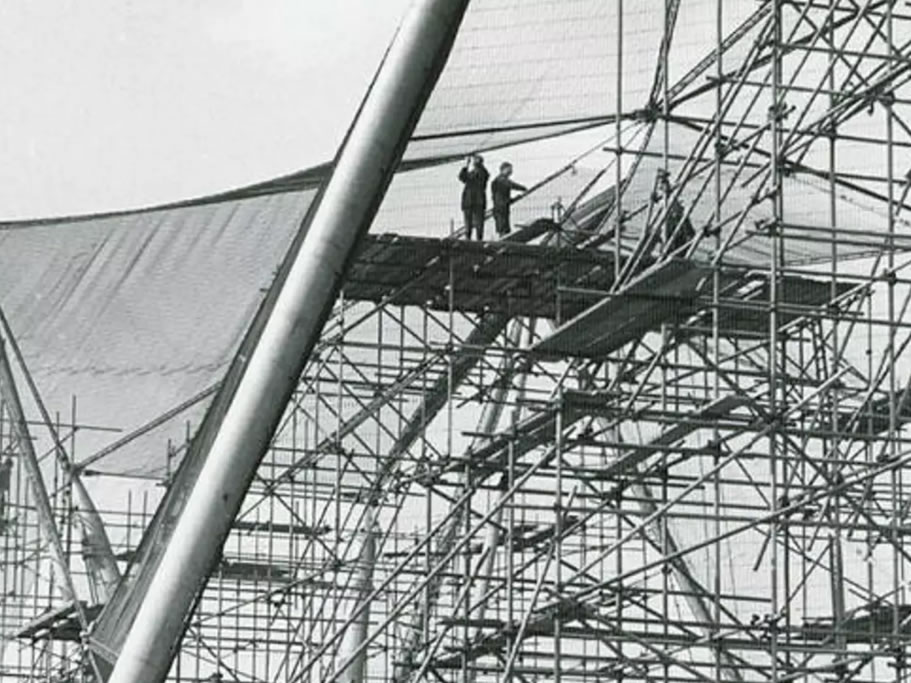
Tensioning a large net from working platforms. The scaffolding is temporary; the geometry it establishes is not — every mast position and cable line set here determines how the finished net carries load for the next decades.
Every escape story starts at a door, and the door arrangement matters more than the mesh — because a net cannot be opened and a gate always can.
The cheapest place to solve all four is the drawing board. Retrofitting an interlock to an existing gate usually means rebuilding the gate frame, because the lock needs a fixed post to strike against.
Prices below are indicative panel-only prices, FOB China, for delivery in 2026. They exclude frames, masts, foundations, freight and installation, which together usually add 60–120% to the mesh line. Treat them as a budget tool for comparing systems, not as a quotation.
| System | Example specification | US$/m² (panels) | Design life |
| Galvanised welded mesh | 50 × 50 mm, 3 mm wire | 8–15 | 8–15 years |
| PVC-coated welded mesh | 25 × 25 mm, 2.5 mm wire | 12–22 | 8–12 years |
| Chain link | 50 × 50 mm, 4 mm wire | 6–12 | 8–12 years |
| Knotted rope mesh, 304 | 60 × 60 mm, 2.0 mm rope | 35–55 | 20–25 years |
| Knotted rope mesh, 316 | 50 × 50 mm, 3.0 mm rope | 48–75 | 25–30 years |
| Ferruled rope mesh, 316 | 60 × 60 mm, 3.0 mm rope | 55–95 | 25–30 years |
| Structural cable net | 150 × 150 mm, 8 mm cable | 70–130 | 30+ years |
Read alone, that table says rope mesh is five to eight times the price of galvanised welded mesh. Read over a design life, it says something different. Take a 1,000 m² enclosure held for 25 years. Galvanised panels at US$10/m² are replaced twice in that period — US$30/m² of mesh before you count frames, access equipment, labour or the cost of closing an exhibit during peak season. Rope mesh at US$60/m² is bought once and rinsed. The stainless option ends up cheaper, and it does not shut the gate twice.
The comparison only fails when the enclosure is genuinely short-life: a temporary quarantine run, a two-season breeding cage, a service compound. For those, buy galvanised and do not apologise for it. The mistake is specifying a 10-year material for a 40-year building.
Almost every enclosure we are asked to re-mesh failed for one of five reasons, and none of them was the mesh itself.
If you take nothing else from this guide, take the sequence. Following it means every supplier quotes to the same basis, which is the only way a price comparison means anything.
Send those six items as one package and a competent supplier will return a panel-by-panel quotation with a fixing schedule attached. Send “about 500 square metres of mesh for monkeys” and you will get seven prices that cannot be compared, and a specification you will have to renegotiate after the frame is fabricated.
XN Wire Mesh manufactures knotted (hand-woven) and ferruled stainless steel rope mesh in 304, 316 and 316L, from 1.2 mm to 5.0 mm rope and 20 mm to 200 mm aperture. Panels are cut and edged to the drawing — knotted border, thimble-and-sleeve, or pressed sleeve on a perimeter cable — and shipped with matching clamps, shackles and tensioners so that the fixings are the same grade as the net. We supply zoos, wildlife parks, aviaries and landscape contractors, and we quote against an elevation drawing with a species list rather than against a square-metre figure.
Related specifications by exhibit type: monkey enclosure mesh, tiger enclosure mesh, lion enclosure fence netting, and for flight exhibits our aviary design and mesh guide. If you are weighing cable net against knotted rope mesh for a large roof, the comparison in stainless steel cable nets for zoo enclosures covers the structural side in more detail.
To get a real number, send your elevations and species list to peter@xnwiremesh.com or WhatsApp +86 182 0318 8606. We will come back with panel sizes, edge details, a fixing schedule and a delivered price — typically within two working days for standard specifications.
Most modern zoo mesh is stainless steel wire rope — 304, 316 or 316L — woven into a knotted or ferruled diamond net, or a structural cable net in 6–12 mm cable. Cheaper enclosures use galvanised or PVC-coated welded steel wire. Stainless is preferred because it does not shed zinc, does not rust and needs no re-coating over a 20–30 year life.
It depends on the smallest head in the enclosure. Marmosets need 20–25 mm, macaques and baboons 40–50 mm, great apes 50–80 mm, lions and tigers 50–100 mm, and hoofed stock 100–150 mm. In mixed exhibits, always specify the aperture for the smallest species present.
Yes, if the strand is sized for the load. A 4 mm 316 rope has a typical breaking load around 12.5 kN and a 6 mm rope around 28 kN; a net distributes an impact across many strands and into the perimeter anchors. Design at one quarter to one fifth of breaking load, and let the anchors rather than the net govern.
As indicative 2026 panel prices: galvanised welded mesh US$8–15/m², chain link US$6–12/m², knotted 304 rope mesh US$35–55/m², knotted 316 US$48–75/m², ferruled 316 US$55–95/m², and structural cable net US$70–130/m². Frames, masts, freight and installation typically add 60–120% to the mesh line.
Stainless rope mesh lasts 20–30 years with nothing more than occasional rinsing, and 316 in a coastal or poolside setting still reaches 20 years. Galvanised welded mesh gives 8–15 years inland and 8–12 years in humid or coastal air, and needs cut edges touching up with zinc-rich paint each year.
Yes — rope mesh is the usual choice for walk-through aviaries and primate exhibits because it is flexible, has no sharp wire ends and is visually quiet at close range. It needs a double-door airlock, a mesh roof, and a solid barrier or setback at visitor height so that visitors and animals cannot reach each other.
Chain link is galvanised steel wire spiralled into a diamond pattern and fixed to rigid posts; zoo mesh is usually stainless rope, tensioned between anchors. Chain link is a sixth of the price and lasts half as long, and its doubled wire edges read as a cage. For primates and public exhibits, rope mesh is the safer and better-looking option.
Any enclosure holding primates, climbing carnivores or birds does. Cats and bears climb and jump; primates use a roof as travel space. A roofed net also removes the need for a high perimeter wall and lets the enclosure gain volume without gaining footprint, which is why most new exhibits are netted as a single continuous surface.
Key takeaways
Zoo mesh is one of the few parts of an enclosure that cannot be upgraded later without closing the exhibit. The frame can be painted, planting can be replaced, interpretation can be rewritten — but changing the net means emptying the habitat. That is the whole argument for specifying aperture, grade and edge detail properly at drawing stage: it is the cheapest hour of the entire project, and the one that decides whether the barrier disappears or dominates the view for the next thirty years.
Last updated: November 2026. Specifications and prices are indicative and should be confirmed against project drawings and a current quotation.
Zoo Mesh and Zoo Enclosure Design: The Complete Specification Guide
 Aviary Guide: Types, Sizes, Aviary Mesh & Costs Explained
 Anti-Drone Nets: The Cost-Effective Shield for Critical Infrastructure in Modern Conflict
 Stainless Steel Rope Net: The Premium Solution for Anti Drone Netting Applications