An aviary is a purpose-built enclosure that gives birds room to fly, not just room to perch. The word covers everything from a 2 m garden flight for budgerigars to a 20,000 m³ walk-through bird park, but every successful aviary balances the same three variables: enclosed volume, mesh specification, and access for cleaning. Get those right and the structure will serve for 20–30 years. Get them wrong and you will be rebuilding within five.
This guide is written for zoo exhibit planners, bird-park operators, breeders and serious hobbyists who need to specify an aviary from scratch — or audit one that is already standing.
Aviary at a glance (key facts)

Scarlet ibis in a walk-through aviary. The curved roof is formed from stainless steel rope mesh on a tubular steel frame — no visible glare, no blind spots for visitors.
An aviary — from the Latin aviarium, "a place where birds are kept", from avis, bird — is an enclosure designed around flight rather than containment alone. That is the functional difference between an aviary and a cage: a cage limits movement, an aviary accommodates it. Aviaries also differ from bird rooms in that the mesh itself, not a wall, is the barrier, which is what allows natural light, airflow and visual contact with the outside.
Purpose-built aviaries are old. Roman households kept aviaria for songbirds and game; the great European zoos of the 19th century turned the idea into public architecture, and the walk-through aviary — where visitors pass through the birds' space instead of looking into it — became a standard exhibit type in the 20th century. Modern aviary design is essentially an engineering problem: span the largest possible volume with the least visible structure, using a mesh that birds cannot injure themselves on and predators cannot breach.
In planning documents you will meet three related structures. They are not interchangeable:
| Structure | What it is | Typical size | Best for |
| Cage | Small enclosure, perching only | 0.3–1 m³ | Single companion bird, hospital, transport |
| Bird room | A converted indoor room, solid walls plus mesh panels | 6–30 m³ | Tropical species, breeding pairs, winter housing |
| Aviary | Mesh-walled flight enclosure, indoor or outdoor | 8 m³ to 20,000 m³+ | Free flight, colonies, mixed exhibits, public display |
Most aviary projects fail at the brief stage, not the build stage. Decide which of these seven types you are actually building before you price a single panel, because each one drives a different mesh specification and a different structural approach.
| Type | Typical use | Volume guide | Mesh note |
| Walk-through / flight aviary | Zoos, bird parks, sanctuaries | 300–20,000 m³ | Rope mesh 25–50 mm aperture, high transparency, large unsupported spans |
| Suspended aviary | Gardens, terraces, courtyards | 8–30 m³ | Welded mesh 25 mm on a cable-suspended frame; nothing to dig |
| Outdoor ground aviary | Hobbyists, small breeders | 10–60 m³ | Welded or rope mesh 25–38 mm, buried skirt against digging predators |
| Breeding flight | Parrot and finch breeders | 1.8 m high × 3–6 m long | 25–40 mm; sight barriers between pairs to reduce aggression |
| Indoor bird room / flight room | Tropical species, quarantine, winter | 6–30 m³ | 13–25 mm aperture; stainless only, because humidity is trapped |
| Display / colony aviary | Mixed-species exhibits, hotels, clinics | 20–200 m³ | 38–50 mm; species compatibility matters more than mesh |
| Window or balcony aviary | Apartments, urban homes | 1–4 m³ | 13–19 mm welded mesh, powder-coated to match the facade |
The type you choose also decides who inspects it. Public exhibits in most countries fall under zoo licensing or animal-welfare legislation, which brings mandatory inspection regimes, record keeping and often a minimum enclosure standard. Private garden aviaries face far less scrutiny — but the welfare logic is identical, and a mesh specification that satisfies a zoo inspector is rarely over-specified for a private collection.
The most widely used sizing heuristic in aviary design is simple: the longest unobstructed flight path should be at least three times the wingspan of the largest bird housed. For a hyacinth macaw with a 1.2–1.4 m wingspan that means a flight of roughly 3.6–4.2 m before the bird has to turn or stall — which is why macaw aviaries are always long and rectangular rather than tall and narrow.
Height matters less than length for most species, but width matters for turning radius: a bird that cannot complete a banked turn will spend its life on a perch. Use the table below as a starting point, then scale up — these are minimums for a single bird or a compatible pair, not for a colony.
| Species group | Typical wingspan | Minimum flight length (3×) | Mesh aperture | Rope / wire diameter |
| Finches, canaries, waxbills | 20–25 cm | 60–75 cm | 13 × 13 mm | 0.8–1.2 mm |
| Budgerigars, lovebirds, cockatiels | 30–40 cm | 0.9–1.2 m | 19 × 19 or 25 × 25 mm | 1.2–1.5 mm |
| Conures, lorikeets, ringnecks | 45–60 cm | 1.4–1.8 m | 25 × 25 mm | 1.5–2.0 mm |
| African greys, Amazons | 60–75 cm | 1.8–2.3 m | 38 × 38 or 50 × 50 mm | 2.0–2.5 mm |
| Macaws, large cockatoos | 100–140 cm | 3.0–4.2 m | 50 × 50 or 60 × 60 mm | 2.5–3.2 mm |
Two practical caveats. First, aperture size is set by the smallest bird in a mixed exhibit, not the largest — a mixed walk-through housing sun conures and diamond doves must use 25 mm mesh even though the conures would be safe behind 50 mm. Second, birds escape by pushing through mesh at corners and door edges, not through the middle of a panel; a perfectly specified aperture still leaks if the perimeter is not clamped or tensioned correctly.
A related question — how aperture size changes with species — is covered in more detail in our guide to choosing aviary mesh size for different bird species.
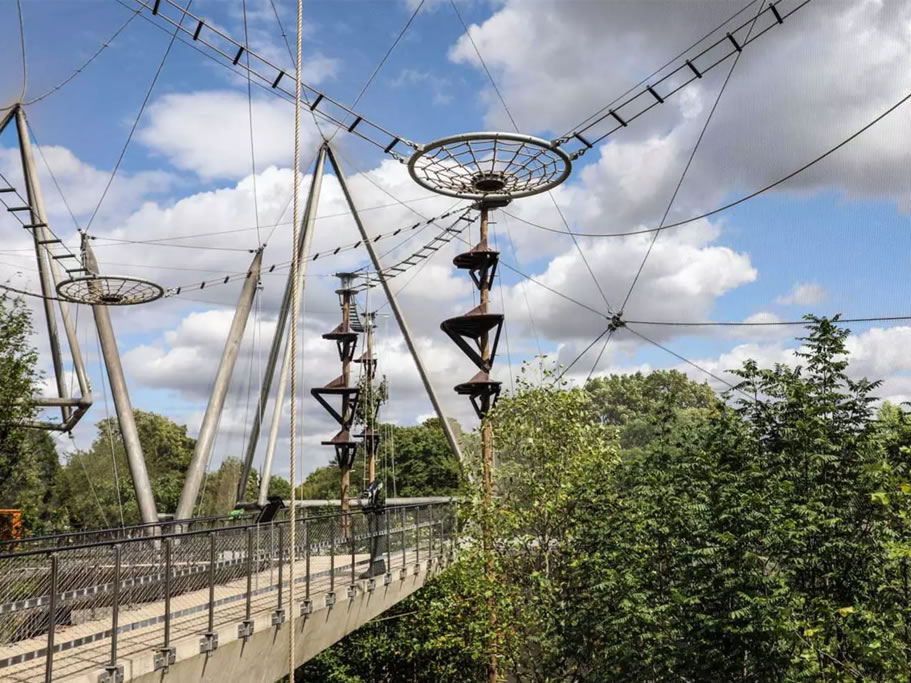
A visitor walkway inside a large aviary. Hanging feeders and perches are suspended from the roof cables, so no load is carried by the mesh itself.
Mesh is 60–70% of the visible cost of an aviary and 100% of its containment performance, so it deserves more thought than the frame. Four families dominate the market.
| Material | Corrosion life | Visibility | Strength / predator resistance | Best used for |
| Galvanised welded mesh | 8–12 years inland; far less near coast | Good at 25 mm, poor at 50 mm | Rigid; deflects predators but dents | Budget outdoor aviaries, aviary base skirts |
| PVC-coated welded mesh | 10–15 years if coating stays intact | Good; colour can be matched to surroundings | Rigid; coating hides early rust but also hides failures | Garden aviaries where aesthetics matter |
| Stainless steel rope mesh — knotted (hand-woven) | 20–30+ years, including coastal | Excellent; 1.5–2 mm rope reads as almost invisible at 5 m | Flexible and very strong; absorbs impact instead of tearing | Walk-through aviaries, zoo exhibits, curved roofs |
| Stainless steel rope mesh — ferrule (cable) | 20–30+ years, including coastal | Excellent, especially at wide apertures | Highest strength-to-weight; spans the largest openings | Very large flight cages, tensioned facade-style enclosures |
For anything larger than a garden flight, stainless steel rope mesh has become the default for three reasons that matter more than unit price:
In practice, most professional aviaries we supply combine both: a rope-mesh flight volume with a galvanised or stainless welded skirt buried 300–500 mm below ground to stop digging predators. Grade selection is straightforward — 304 for inland and general use, 316 wherever the air carries chlorides (coastlines, indoor pools, marine exhibits). The mechanical difference is molybdenum in 316, which resists pitting corrosion in chloride environments where 304 will eventually stain and pit.
Standard stainless rope mesh for aviary work runs from 25 × 25 mm to 125 × 125 mm aperture, in rope diameters of 1.2 mm to 3.2 mm, with tensile strength typically in the 690–760 MPa (100,000–110,000 psi) range. You can see the full specification grid, including model codes for each aperture-and-diameter combination, on our aviary mesh product page, with construction types compared on the hand-woven knotted mesh and wire rope ferrule mesh pages.

Hyacinth macaw behind hand-woven stainless steel rope mesh. Note the double-fastened knots and the smooth, burr-free surface — the two details that stop feather and foot injuries.
Steps 4 to 6 are where most projects lose time, and they are covered in build-level detail in our guides to building a large aviary with stainless steel rope mesh and to large aviary design, material selection and maintenance.
Aviary budgets are dominated by two line items: mesh area and steel. Everything else — feeders, planting, signage, groundworks — is a rounding error by comparison. The figures below are indicative 2026 factory-gate ranges for materials, quoted per square metre of enclosure surface (walls plus roof). Local retail prices, labour and freight will be higher.
| Line item | Typical specification | Indicative cost |
| Galvanised welded mesh | 2.5 mm wire, 50 × 50 mm | US$10–25 / m² |
| PVC-coated welded mesh | 2.0–3.0 mm wire, 25–50 mm | US$15–30 / m² |
| Stainless rope mesh, knotted | 1.5–2.0 mm rope, 40–50 mm | US$35–70 / m² |
| Stainless rope mesh, ferrule | 2.0–3.0 mm rope, 60–100 mm | US$45–90 / m² |
| Frame and bracing | Tubular steel, galvanised | US$25–60 / m² of elevation |
| Double-door airlock | Two doors, 1.5 m vestibule, closers | US$600–2,500 per unit |
Worked example: a 6 × 3 × 3 m outdoor macaw flight has about 90 m² of enclosure surface. In 50 mm stainless knotted mesh at US$45–70/m², the mesh alone lands at roughly US$4,000–6,300, with the frame adding US$2,000–5,000. The same enclosure in galvanised welded mesh costs perhaps a third — and needs replacing in a decade. Over a 25-year design life, the cheap mesh is usually the more expensive choice.
| Frequency | Task | Why it matters |
| Daily | Remove droppings and food waste; check water; count birds | Detects escapes and illness within a day, not a week |
| Weekly | Clean feeders and drinkers; rake substrate; walk the perimeter | Feeding stations are where disease and rodents concentrate |
| Monthly | Check every clamp, ferrule and tensioning point; test both airlock doors | Loose fastenings are the number-one cause of escapes |
| Quarterly | Inspect mesh intersections for broken strands or weld failures; trim vegetation touching the mesh | Abrasion from branches destroys mesh far faster than weather |
| Annually | Full structural inspection after storm season; replace sacrificial skirt mesh if corroded; refresh substrate | Storm damage is cumulative and invisible from ground level |
Stainless mesh needs almost nothing beyond inspection — a fresh-water rinse where salt has dried is usually enough. Galvanised mesh needs more: touch up cut edges with zinc-rich paint every year, and expect to replace panels at the 8–12 year mark in humid or coastal climates.
An aviary is large enough for a bird to fly inside; a cage only allows perching and climbing. The practical threshold is the 3× wingspan rule — below that flight length a bird cannot complete a level flight, and the enclosure functions as a cage regardless of what it is called.
At minimum, three times the bird's wingspan in the longest dimension. For an African grey (about 70 cm wingspan) that is roughly 2.1 m; for a macaw (1.2–1.4 m) it is 3.6–4.2 m. Width should allow a banked turn, so keep the length-to-width ratio at about 2:1.
13 × 13 mm for finches and canaries, 25 × 25 mm for budgerigars, conures and lorikeets, 38–50 mm for greys and Amazons, and 50–60 mm for macaws and large cockatoos. In a mixed exhibit, always specify to the smallest species present.
For any aviary intended to last more than ten years, usually yes. Stainless rope mesh typically costs two to three times more per square metre than galvanised welded mesh but lasts two to three times longer, needs no re-coating, and does not shed zinc. Across a 25-year design life it is normally the cheaper option, and it is the only sensible choice within 5 km of a coast.
It depends on the jurisdiction and on height, floor area and whether the property is listed. Many countries exempt small garden structures below roughly 2 m in height and 15 m² in footprint, while public or commercial exhibits almost always require consent plus animal-welfare licensing. Confirm with your local planning authority before ordering materials — retrofitting compliance is far more expensive than designing for it.
Yes, and for tropical species it is often the better option. Indoor aviaries need mechanical ventilation and a humidity check, because trapped moisture is what corrodes mesh and causes respiratory problems. Use stainless mesh only, and keep the mesh clear of any wall by at least 100 mm so air can move behind it.
Three measures together: a buried or outward-turned mesh skirt of 300–500 mm at the base, mesh apertures no larger than 25 mm in the lower 1 m of the enclosure, and a fully roofed or netted top. Raccoons and rats defeat two of the three on their own — all three are needed.
Knotted stainless steel rope mesh. It is flexible enough to follow a compound curve without pre-forming, and because it is not tensioned like a cable system it can be clamped to a curved tubular frame directly. Welded panels cannot be curved without permanent deformation of the wires.
XN Wire Mesh manufactures hand-woven and ferrule stainless steel rope mesh in 304 and 316 grades, from 25 × 25 mm to 125 × 125 mm aperture and 1.2–3.2 mm rope diameter, cut and edged to the panel sizes your frame actually needs. We supply zoo exhibits, bird parks, breeders and landscape contractors, and we will quote against a simple elevation drawing with dimensions and species list.
Send your aviary dimensions and species list to peter@xnwiremesh.com or WhatsApp +86 182 0318 8606 for a specification review and a panel-by-panel quotation. Related reading: how to choose aviary netting and why aviary netting matters more than you think.
Aviary Guide: Types, Sizes, Aviary Mesh & Costs Explained
 Anti-Drone Nets: The Cost-Effective Shield for Critical Infrastructure in Modern Conflict
 Stainless Steel Rope Net: The Premium Solution for Anti Drone Netting Applications
 How to Choose Lion Mesh: Practical Scenarios & Specification Recommendations